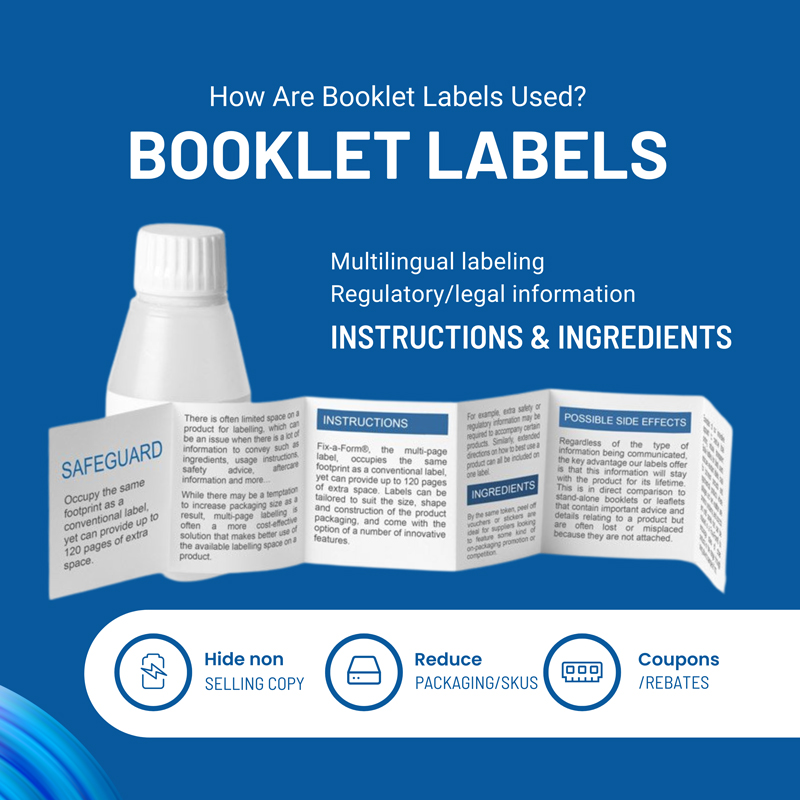
For skincare, cosmetics, essential oils, shampoo, and other personal care products, packaging space is often limited. Small bottles, tubes, and jars may need to display ingredients, directions, warnings, product claims, usage information, and regulatory details while still maintaining a clean and attractive appearance.
This is where booklet labels can provide a practical packaging solution.
Instead of increasing the size of the primary label or redesigning the package, a booklet label adds multiple printable panels within a compact footprint. When closed, the label maintains a neat appearance on the package. When opened, additional pages provide space for detailed product information.
For brands developing custom soap labels, skincare packaging, cosmetic bottles, or other personal care products, this structure can provide both presentation and information capacity.
Personal care products often have more information requirements than their package size suggests.
A small cosmetic bottle, for example, may need to include:
Product name and brand
Ingredients
Directions for use
Warnings and precautions
Product claims
Storage instructions
Manufacturer information
Batch or lot information
Barcode or QR code
Multiple languages
Putting everything on the front of a small package can make the label crowded and difficult to read.
A larger label may solve the information problem, but it can also cover more of the packaging and reduce the visual impact of the product.
Booklet labels provide another option: keep the external footprint compact while expanding the available information area.
Soap packaging is a good example of where label design needs to balance appearance and information.
A custom soap label may need to communicate the product name, scent, ingredients, usage information, brand story, and other product details. For handmade soap and personal care brands with several product variants, the label also needs to maintain consistent branding across different fragrances and formulas.
For brands that need a simpler branding solution, Custom Label Stickers can also be used to display logos, product names, specifications, and other essential information on packaging.
Depending on the packaging format, a booklet-style label can provide additional space for:
Ingredient information
Fragrance descriptions
Directions
Product benefits
Usage recommendations
Brand information
Multiple languages
QR codes
This allows the front of the packaging to remain relatively clean while additional information is placed inside the booklet section.
Skincare products frequently use relatively small packaging, including bottles, tubes, jars, and sample containers.
A skincare product label may need to communicate ingredients, application instructions, warnings, claims, and product information.
For products with extensive content, booklet labels for skincare products can provide additional printable panels without requiring a larger container.
For international brands, the additional space can also be useful for multilingual content. For simpler skincare packaging, Packaging Labels can provide a practical option for displaying product information, ingredients, usage instructions, and branding.
Cosmetic bottles come in many different shapes and sizes, and available labeling space can be limited.
A conventional label may be sufficient for the brand name and basic product information, but it may not provide enough room for detailed instructions or multilingual content.
A custom cosmetic bottle label can incorporate a booklet structure to increase information capacity while keeping the bottle's overall appearance clean.
This is particularly useful for:
Facial cleansers
Toners
Serums
Body lotions
Liquid makeup
Hair care products
The final construction should be selected according to the bottle material, curvature, surface finish, adhesive requirements, and expected handling conditions.
For curved bottles and containers with specific surface requirements, Custom Adhesive Labels can be customized according to the required size, shape, material, and adhesive performance.
Essential oil bottles are typically small, which makes label space particularly valuable.
A conventional small label may need to communicate:
Oil name
Botanical information
Directions
Dilution information
Safety warnings
Storage instructions
Ingredients
Batch information
A custom essential oil label with additional printable panels can provide more room for this information without making the primary label visually overwhelming.
For small glass bottles, adhesive selection is also important. The label construction should be tested against the bottle surface, curvature, oil exposure, and storage environment.
Shampoo and conditioner packaging often encounters water, humidity, repeated handling, and bathroom environments.
Labels therefore need to consider both information capacity and durability.
A shampoo or conditioner label may include:
Ingredients
Directions for use
Hair type information
Product benefits
Warnings
Storage information
Brand messaging
Multiple languages
For products requiring extensive content, a booklet label can provide additional printable space while maintaining a compact label footprint.
For products exposed to water and humidity, material selection becomes especially important. Sticker Labels can be customized with different materials and finishes for applications where durability, adhesion, and visual quality are important.
Material and adhesive selection should be matched to the packaging surface and moisture exposure.
Cosmetic jars are commonly used for creams, masks, balms, scrubs, and other personal care products.
The available label area can be restricted by the jar diameter, lid design, and overall packaging structure.
A custom cosmetic jar label can be designed around the actual container dimensions, with the booklet portion providing additional space for ingredients, directions, warnings, and product information.
For jars that are frequently opened and closed, the label construction should also be evaluated for resistance to handling, moisture, oils, and abrasion.
The same principle applies across a wide range of personal care products.
Examples include:
Body care products
Hair care products
Bath products
Hand care products
Oral care products
Shaving products
Deodorants
Beauty treatments
Different products have different information and performance requirements. Some need additional text, while others require better resistance to moisture, oils, chemicals, or repeated handling.
A custom label solution should therefore consider both what information needs to be printed and where the product will be used.
The main advantage of a booklet label is not simply its appearance. It is its ability to provide more printable space within a relatively compact package footprint.
| Requirement | Standard Label | Booklet Label |
|---|---|---|
| Basic product information | ✓ | ✓ |
| Large amount of text | Limited | ✓ |
| Multiple languages | Limited | ✓ |
| Detailed instructions | Limited | ✓ |
| Ingredient information | ✓ | ✓ |
| Safety information | Limited | ✓ |
| Additional printable pages | No | ✓ |
For a product with only a small amount of information, a standard label may remain the most efficient option. For products with extensive content, a booklet label can provide significantly greater information capacity without requiring a proportionally larger package label.
For personal care packaging, printing quality is an important part of the final label performance. Brands may require detailed text, strong brand colors, product information, decorative elements, or premium finishes depending on the packaging design.
For simple branding applications, logo stickers can provide a flexible way to add brand identification to bottles, jars, boxes, shipping packages, and other products. Custom logo stickers can be produced in different materials, shapes, finishes, and adhesive options according to the packaging surface and application environment.
For more information-intensive packaging, especially when a product requires ingredients, instructions, warnings, multilingual content, and other detailed information, booklet labels provide significantly more printable space than a conventional single-panel label.
The appropriate printing process depends on the label material, artwork, production volume, color requirements, surface finish, and application environment. Digital printing can be suitable for variable information, detailed graphics, and shorter production runs, while other printing technologies may be preferred for specific durability or visual requirements.
For customers comparing a silk screen printing label with other printing methods, screen printing can be considered when the project requires strong solid colors, a heavier ink deposit, or a distinctive premium appearance. The most suitable process should be selected according to the actual label material, artwork, quantity, and performance requirements.
For food and beverage manufacturers that produce their own labels, selecting the best label printer for food packaging also requires more than comparing printer specifications. Material compatibility, printing resolution, moisture resistance, adhesive performance, barcode quality, refrigerated storage, and production volume should all be evaluated.
For many brands, outsourcing custom printed labels can be more practical than purchasing and maintaining in-house printing equipment, particularly when the project requires specialized materials, booklet structures, custom adhesives, or professional finishing.
For personal care packaging, label performance depends on more than printing quality.
Before selecting the label construction, manufacturers should evaluate:
Glass, PET, HDPE, PP, and other plastics can have different surface characteristics and adhesion requirements.
Shampoo, conditioner, soap, and bath products may be exposed to water and high humidity.
Essential oils, creams, lotions, and certain cosmetic formulations can come into contact with the label during use.
Curved bottles and small-diameter containers may require a label construction and adhesive suitable for the specific surface geometry.
A label for a short-term promotional product may have very different requirements from a label expected to remain intact throughout the entire product life cycle.
For this reason, adhesive selection should be based on the actual packaging substrate and application environment rather than simply choosing the strongest available adhesive.
Booklet labels give personal care brands greater flexibility when packaging space is limited.
Instead of increasing the size of the container or covering more of the package with a large conventional label, brands can use additional folded panels to organize detailed information while preserving the main visual presentation.
For custom soap labels, skincare product labels, cosmetic bottle labels, essential oil labels, shampoo and conditioner labels, cosmetic jar labels, and other personal care product labels, the label structure can be customized according to:
Label dimensions
Number of pages
Material
Adhesive
Printing requirements
Folding structure
Finishing
Packaging surface
Application method
Depending on the packaging requirements, JINXIN can provide different label solutions ranging from simple logo stickers and product labels to more information-intensive booklet labels. The appropriate structure can be selected according to the amount of information, packaging size, material, adhesive requirements, and application environment.
For manufacturers that need a combination of product identification and brand presentation, Custom Label Stickers offer another flexible option for bottles, jars, boxes, and retail packaging.
The result is a label solution designed not only to look professional, but also to provide the information capacity and physical performance required by the product.
JINXIN provides custom label solutions for brands and manufacturers that need to balance product presentation, information capacity, adhesion, and durability.
For small personal care packaging, our label solutions can be developed around the actual container size and application requirements. Whether you need custom soap labels, skincare product labels, cosmetic bottle labels, essential oil labels, shampoo and conditioner labels, cosmetic jar labels, or personal care product labels, the appropriate label material, adhesive, structure, and finishing can be evaluated according to the application.
For products that require more information than a conventional label can accommodate, Smart Labels and booklet-style structures provide an efficient way to expand printable space without significantly increasing the package footprint.
For applications requiring greater durability or specialized identification, JINXIN also offers Industrial Labels designed for demanding environments where moisture, temperature changes, abrasion, and traceability requirements need to be considered.
Provide your product packaging dimensions, label size, material requirements, artwork, quantity, and application conditions.
JINXIN can help develop a custom label solution based on your packaging and production requirements.

JINXIN Packaging is a printing company focusing on self-adhesive label printing, colour label printing, multi-layer labels, folding lu labels, and at the same time, the company is a printing company that has passed the FSC certification!
Copyright © 2026 JINXIN Packaging All rights reserved. Privacy policy 丨 Terms and conditions


 English
